Computational chemistry. . .
Computational Chemistry
(under construction)
We utilize several computational approaches to aid our
experimental structure determination of
weakly bound complexes or stable molecules. There are many different levels of
calculation available to us, ranging from relatively simple, semi-empirical
calculations (which can take from a few seconds to a few minutes to complete)
to fully fledged ab initio calculations (which can take several days or
sometimes even several
weeks to complete). We can calculate the lowest energy (most stable)
arrangement of the atoms for these species and hence predict what the
rotational spectrum should look like.Computational chemistry software provide not only structural predictions but also furnish
additional properties such as
dipole moment, electronic charge distribution,
electric field gradients at certain nuclei (which
can be useful to interpret hyperfine splittings within rotational spectra),
and barriers to internal rotation.
Semi-empirical programs (such as the
ORIENT
program of
Anthony Stone)
are much less computationally expensive than the
ab initio software and provide a relatively fast way to examine a large number
of possible conformations. The relative stabilities of these geometries
can be explored using semi-empirical techniques and then the lowest
energy structures may be further explored using ab initio techniques, using
the optimized semi-empirical structures as starting points.
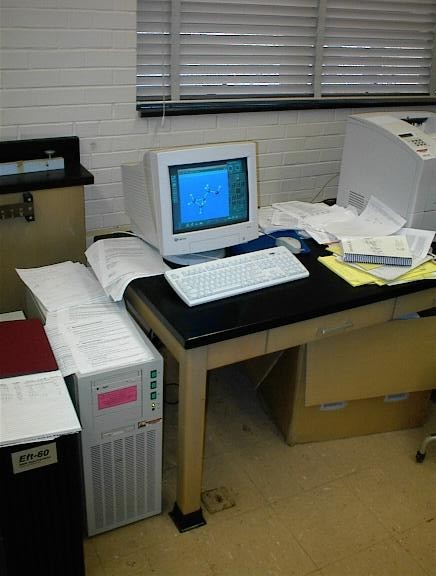
Perhaps what follows is more of a history of the computational resources that we have worn out in the last several years...
Compaq AlphaPC 264DP Workstation - A dual processor
(two 500MHz Alpha EV6 cpu's)
workstation running Tru64 Unix, providing a stable platform for the
calculations too large for the PC to handle. This machine has
1GB RAM and also runs the Gaussian
98 software (although it is not set up for parallel processing with this
software package). OpenPBS
(Portable Batch System) software has recently
been installed on this workstation allowing multiple users to
submit their jobs to various queues, thus ensuring
optimum utilization of the system's resources.
This workstation belongs to the Department of Chemistry
and is also used in the teaching of upper level Chemistry courses that involve
computational chemistry or molecular spectroscopy (such as CHM3915, CHM3920,
CHM4770 or CHM5300). This workstation died in December 2006 and has since been replaced with a Penguin Computing workstation - details below.
Penguin Computing Tempest 2150 Workstation.
-
Two dual-core AMD Opteron 285 CPU's
- 16 GB RAM
- Operating System: RedHat Enterprise Linux 4
- Software: Gaussian 03/GaussView and GAMESS
The Penguin workstation computer started acting flaky in about 2012 and was replaced by a Dell workstation with the following specifications.
Dell Precision T7500 Workstation
- Dual 6-core Intel Xeon CPU's
- 48 GB RAM
- Operating System: Red Hat Enterprise Linux 6
- Batch queue software: SQS (the Simple Queuing System)
- Software: Gaussian 09 Rev. C.01, GaussView 5, SAPT2012, GAMESS
Ubuntu Linux - we have a couple of low end computers running Ubuntu desktop and these have worked quite well (SAPT2012 and GAMESS installations were actually a lot smoother on this distribution than they were on the Red Hat Linux box)
Gaussian Inc. - providers of the
Gaussian suite of programs
Wavefunction Inc. - providers of
Spartan software
GAMESS - the
General Atomic and Molecular Electronic Structure System (GAMESS) ab
intio quantum chemistry package
CADPAC -
the Cambridge Analytic Derivatives Package

Contact information
Email sapeebles@eiu.edu
or call me at (217) 581-2679.
This page has been viewed  times since May 2nd 2003, probably mainly by me.